Journal of Socio-Cultural Studies of Khorasan

Journal of Socio-Cultural Studies of Khorasan

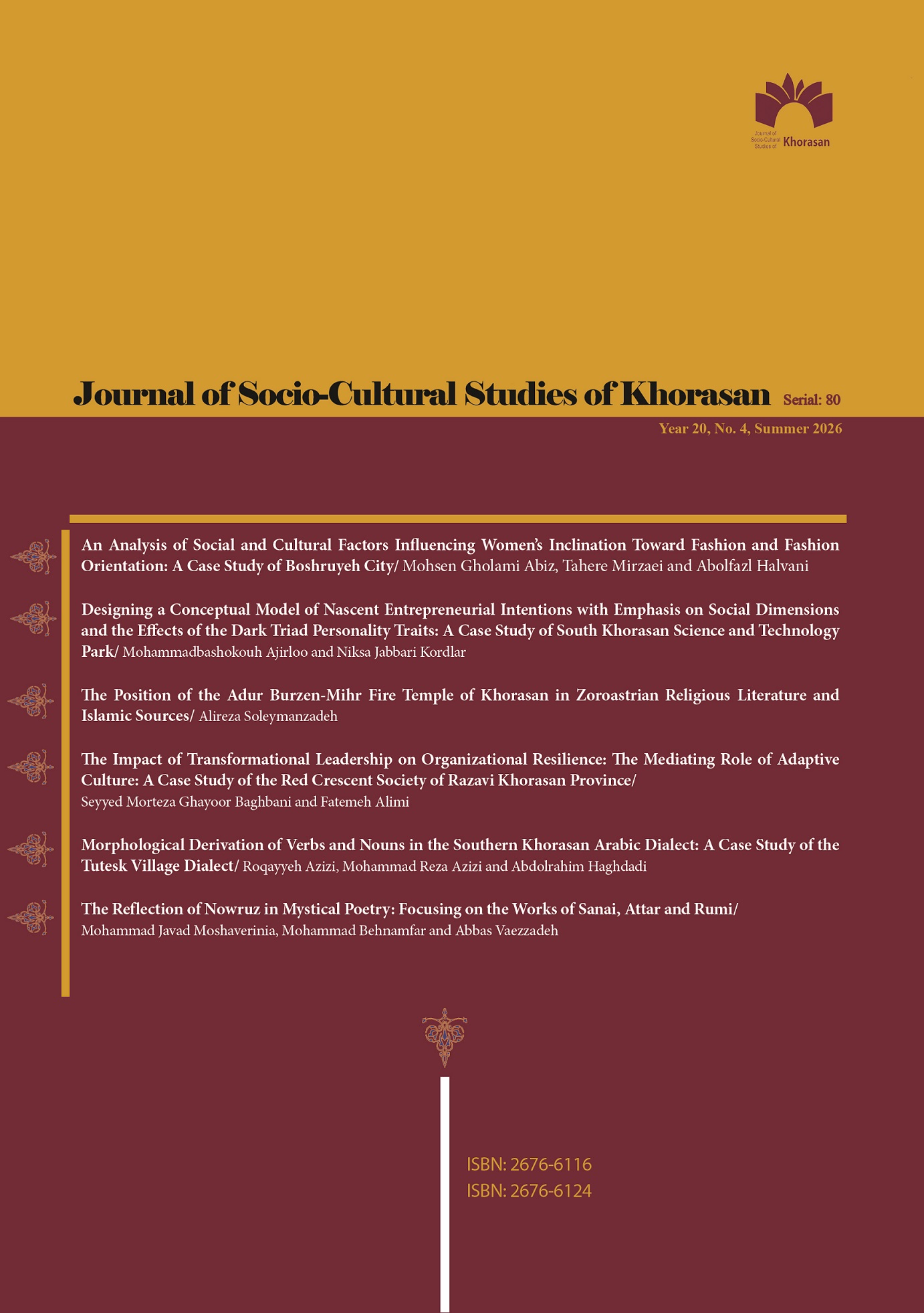
Designing a Conceptual Model of Nascent Entrepreneurial Intentions with Emphasis on Social Dimensions and the Effects of the Dark Triad Personality Traits: A Case Study of South Khorasan Science and Technology Park

Authors
1 Professor, Department of Business Administration, Faculty of Social Sciences, University of Mohaghegh Ardabili, Ardabil, Iran
2 PhD Candidate in Marketing, Department of Business Administration, Faculty of Social Sciences, University of Mohaghegh Ardabili, Ardabil, Iran
Abstract
Introduction
Nascent entrepreneurial intentions refer to an individual’s conscious willingness to establish a new venture and are considered one of the most important antecedents of entrepreneurial behavior. The formation of such intentions is not solely determined by individual characteristics; rather, it is influenced by the interaction of personality traits, social factors, and contextual conditions. Among these factors, the Dark Triad personality traits, including narcissism, Machiavellianism and psychopathy may, under certain circumstances, enhance entrepreneurial intentions due to their associations with ambition, competitiveness, risk-taking and self-interest orientation. However, when these traits are excessive or persistent, they may generate adverse ethical and social consequences for stakeholder relationships and business sustainability (Bogatyreva et al., 2021; Cai et al., 2021; Khawar et al., 2022). Conversely, social capital, social support, and interpersonal networks strengthen the development and continuation of entrepreneurial intentions by providing access to resources, information, emotional support, and emerging opportunities (Cogan et al., 2022; Emami et al., 2023; Awaworyi Churchill et al., 2023). Despite growing interest in these factors, previous studies have predominantly examined personality characteristics and social factors independently, while the systematic interaction between these dimensions, most notably within the context of science and technology parks in less-developed regions of Iran, has received limited attention. Therefore, this study designs a conceptual model of nascent entrepreneurial intentions and explain the interaction between social dimensions and Dark Triad personality traits within the context of South Khorasan Science and Technology Park. The main research question is:
· How do social dimensions and personality traits interact in shaping nascent entrepreneurial intentions?
Method
This study adopted a qualitative approach and employed the systematic grounded theory method proposed by Strauss and Corbin. The research context consisted of nascent companies established in South Khorasan Science and Technology Park in Birjand (Iran). The research population included founders, managers and key experts of startup companies. The sample was selected through purposive and theoretical sampling, which continued until theoretical saturation was achieved. Indeed, 15 startup founders, including five women and ten men, participated in the study. The inclusion criteria consisted of having at least three years of experience in entrepreneurship or startup management, possessing in-depth knowledge of the entrepreneurial ecosystem within the science and technology park, and being willing to participate in in-depth interviews. Data were collected through face-to-face semi-structured interviews, with each interview lasting approximately 60 to 90 minutes. All interviews were recorded and transcribed verbatim with participants’ consent. To enhance the credibility of the findings, member checking, data triangulation through the park’s documents and reports, and reviews by two experts in entrepreneurship and qualitative research methodology were employed. Data analysis was conducted through three stages of coding: open, axial and selective coding. During the open coding stage, 128 codes were identified; in the axial coding stage, 25 categories were developed; and in the selective coding stage, 10 core categories were extracted. The relationships among the categories were subsequently organized within the final paradigm model.
Results
The findings revealed that nascent entrepreneurial intentions are a multidimensional and context-dependent phenomenon shaped by the interaction of personality characteristics, social capital, communication networks as well as economic, cultural and social conditions. Three main categories were identified as causal conditions: dark personality traits, positive personality traits and social capital. The Dark Triad traits, including narcissism, Machiavellianism and psychopathy possessed a dual nature. Narcissism could strengthen the motivation to engage in entrepreneurship by enhancing self-confidence, ambition, and the desire for recognition. In contrast, Machiavellianism and psychopathy could, under certain circumstances, facilitate entrepreneurial intentions through increased risk-taking propensity and a focus on personal interests; however, they could simultaneously increase the likelihood of manipulative behaviors, damaged relationships, and ethical challenges. This finding is consistent with previous evidence regarding the dual role of dark personality traits in entrepreneurship (Wu et al., 2019; Hollebeek et al., 2022; Khawar et al., 2022). Alongside dark personality traits, positive personality characteristics, including self-confidence, courage, risk-taking propensity, self-control and emotional intelligence were identified as influential factors. Furthermore, social capital, comprising social networks, emotional support, and social cohesion, emerged as one of the most important causal conditions contributing to the formation of nascent entrepreneurial intentions. At the contextual level, economic and market developments, competitive pressures, resource fluctuations, technological changes, gender differences in access to social support, and market capacities and challenges were identified as significant factors. Intervening conditions included individual experiences and skills, social networks and interpersonal connections, creativity and innovation, financial resources, and decision-making power. At the strategic level, the findings highlighted the importance of strengthening social cohesion, developing partnerships and collaborations, designing supportive and educational programs, and providing training and assessment of prominent personality characteristics. The consequences included enhanced individual motivations, economic and social success, employment creation, improvement of managerial and leadership skills, and enhancement of individuals’ psychological and social well-being. Finally, the ten selective codes were integrated around the core phenomenon of ‘nascent entrepreneurial intentions’, leading to the development of the final conceptual model of the study.
Discussion and Conclusion
The findings demonstrated that the formation of nascent entrepreneurial intentions cannot be explained solely by individual characteristics or social factors; rather, this phenomenon emerges from the dynamic and context-dependent interaction of these dimensions. A key contribution of this study is the identification of the dual nature of Dark Triad personality traits. Specifically, traits such as narcissism, Machiavellianism, and psychopathy may, under competitive conditions, stimulate entrepreneurial intentions by enhancing ambition, risk-taking propensity, and goal orientation. However, in the absence of self-control and ethical considerations, these traits may threaten business sustainability and social relationships. In contrast, social support, communication networks, and both bonding and bridging social capital play critical roles in providing access to resources, information, and psychological support, particularly within the cultural context of South Khorasan. Accordingly, policymakers and managers of science and technology parks can develop programs focused on self-awareness, self-regulation, and professional ethics, as well as networking mechanisms and targeted support initiatives for women entrepreneurs. Future research is encouraged to test the proposed model in other science and technology parks and neighboring provinces, and to examine the interaction between personality traits and social factors under different economic and cultural conditions.
Keywords
Subjects

Ahmadi Azar, P., & Jahan, F. (2019). Wisdom and character, emotions, and Dark Triad personality traits: A structural equation model. Journal of General Psychology, 12(1), 77–92. [In Persian]
Ajzen, I. (2002). Perceived behavioral control, self-efficacy, locus of control, and the theory of planned behavior. Journal of Applied Social Psychology, 32(4), 665–683.https://doi.org/10.1111/j.1559-1816.2002.tb00236.x
Ali, A., & Khan, Y. (2023). Narcissism and entrepreneurship: Evidence from Malaysia Realm. Information Management and Business Review, 15(3), 236–241.https://doi.org/10.22610/imbr.v15i3(I).3532
Anderson, M., Devlin, A. M., Pickering, L., McCann, M., & Wight, D. (2021). “It’s not 9 to 5 recovery”: The role of a recovery community in producing social bonds that support recovery. Drugs: Education, Prevention and Policy, 28(5), 475–485. https://doi.org/10.1080/09687637.2021.1933911
Awaworyi Churchill, S., Hayward, M., Smyth, R., & Trinh, T.-A. (2023). Crime, community social capital and entrepreneurship: Evidence from Australian communities. Journal of Business Venturing, 38, 106291. https://doi.org/10.1016/j.jbusvent.2023.106291
Bogatyreva, K., Laskovaia, A., Klemina, T., & Orekhova, Y. (2021). “The good, the bad and the ugly”? The influence of Dark Triad personality traits on formation of entrepreneurial intentions. Vestnik of Saint Petersburg University. Management, 20, 293–325. https://doi.org/10.21638/11701/spbu08.2021.301
Cai, L., Murad, M., Ashraf, S. F., et al. (2021). Impact of Dark Tetrad personality traits on nascent entrepreneurial behavior: The mediating role of entrepreneurial intention. Frontiers of Business Research in China, 15(1). https://doi.org/10.1186/s11782-021-00103-y
Chinta, R., & Collier, D. (2022). Interplay of antecedents in nascent entrepreneurship: Conceptual model and research propositions. Journal of the International Council for Small Business, 3(4), 292–302. https://doi.org/10.1080/26437015.2022.2089074
Clark, D., Tanner, T., Pham, L., Lau, W., & Nguyen, D. D. L. (2020). Attitudes toward business ethics: Empirical investigation on different moral philosophies among business students in Vietnam. International Journal of Business Governance and Ethics, 14, 1. https://doi.org/10.1504/IJBGE.2020.10023486
Cogan, A., Pret, T., & Cardon, M. S. (2022). Everyday social support processes: Household members’ instrumental and emotional support of entrepreneurs. International Small Business Journal, 40(5), 537–563. https://doi.org/10.1177/02662426211054098
Dobbin, K., & Smith, D. (2021). Bridging social capital theory and practice: Evidence from community-managed water treatment plants in Honduras. Journal of Rural Studies, 88, 181–191. https://doi.org/10.1016/j.jrurstud.2021.10.002
Emami, A., Ashourizadeh, S., & Packard, M. D. (2023). The impact of social network support on opportunity intention among prospective male and female entrepreneurs during the 2019-nCoV pandemic. International Journal of Entrepreneurial Behavior & Research, 29(11), 132–169. https://doi.org/10.1108/IJEBR-03-2022-0223
Hollebeek, L. D., Sprott, D. E., Urbonavicius, S., Sigurdsson, V., Clark, M. K., Riisalu, R., & Smith, D. L. G. (2022). Beyond the Big Five: The effect of Machiavellian, narcissistic, and psychopathic personality traits on stakeholder engagement. Psychology & Marketing, 39(6), 1230–1243. https://doi.org/10.1002/mar.21647
Jamshidi, S., Noferesti, A., & Farahani, H. (2024). Examining the Relationship Between Problematic Social Media Use and Dark Personality Traits with the Mediating Role of Emotion Regulation and Self-Compassion in Adult Instagram Users in Tehran. Health Nexus, 2(3), 49-59. https://doi.org/10.61838/kman.hn.2.3.7
Khalili Khezrabadi, M., & Hassani, M. (2023). The relationship between entrepreneurial social identity and entrepreneurial intention: the mediating role of entrepreneurial self-efficacy. Journal of Productivity Management, 17(4), 209–232. [In Persian]
Khawar, R., Amin, R., Zulfqar, A., Hussain, B., & Muqaddas, F. (2022). Dark personality traits and entrepreneurial intentions among Pakistani university students: The role of executive functions and academic intent to entrepreneurship. Frontiers in Psychology, 13, 989775. https://doi.org/10.3389/fpsyg.2022.989775
Leung, Y. K., Franken, I., Thurik, R., Driessen, M., Kamei, K., Torrès, O., & Verheul, I. (2021). Narcissism and entrepreneurship: Evidence from six datasets. Journal of Business Venturing Insights, 15, e00216. https://doi.org/10.1016/j.jbvi.2020.e00216
Lingnau, V., Fuchs, F., & Dehne-Niemann, T. (2017). The influence of psychopathic traits on the acceptance of white-collar crime: Do corporate psychopaths cook the books and misuse the news? Journal of Business Economics, 1–35. https://doi.org/10.1007/s11573-017-0864-6
Murad, M., Wang, M., Shah, S. H., & Islam, M. (2024). Transitioning from entrepreneurial education to entrepreneurial behavior: The role of opportunity recognition, entrepreneurial social networks, and risk-taking propensity. The International Journal of Management Education, 22, 101053. https://doi.org/10.1016/j.ijme.2024.101053
Myznikov, A., Korotkov, A., Zheltyakova, M., Kiselev, V., Masharipov, R., Bursov, K., Yagmurov, O., Votinov, M., Cherednichenko, D., Didur, M., & Kireev, M. (2024). Dark Triad personality traits are associated with decreased grey matter volumes in “social brain” structures. Frontiers in Psychology, 14, 1326946. https://doi.org/10.3389/fpsyg.2023.1326946
Olumekor, M., Mohiuddin, M., & Su, Z. (2023). Effective altruism and the dark side of entrepreneurship. Frontiers in Psychology, 14, 1247331.https://doi.org/10.3389/fpsyg.2023.1247331
Ostrom, E. (2000). Collective action and the evolution of social norms. Journal of Economic Perspectives, 14(3), 137–158. https://doi.org/10.1257/jep.14.3.137
Özdemir, Gökçe & BAŞAR, Ahmet. (2024). A Study on the Relationship between Teachers’ Dark Triad Personality Traits and Organizational Cynicism BehavioursÖğretmenlerin Karanlık Üçlü Kişilik Özellikleri ile Örgütsel Sinizm Davranışları Arasındaki İlişki Üzerine Bir Çalışma. Korkut Ata Türkiyat Araştırmaları Dergisi. 10.51531/korkutataturkiyat.1410217.
Pandey, D. L., Uprety, S. K., & Risal, N. (2023). Personality traits and their impact on the social entrepreneurial intentions of management students: A test of Big Five personality approach. Journal of Innovation and Entrepreneurship, 12(1). https://doi.org/10.1186/s13731-023-00342-8
Razzaque, A., Lee, I., & Mangalaraj, G. (2024). The effect of entrepreneurial leadership traits on corporate sustainable development and firm performance: A resource-based view. European Business Review, 36(2), 177–200. https://doi.org/10.1108/EBR-03-2023-0076
Rijal, S., Utomo, B., & Ramdhani, R. (2024). The influence of social capital on entrepreneurial success: A study of networks and relationships in MSMEs. International Journal of Business, Law, and Education, 5(2), 1686–1696. https://doi.org/10.56442/ijble.v5i2.678
Ślusarczyk, B., Moghavvemi, S., & Tehseen, S. (2023). Women and business: Empirical study on economic constraints, legal conditions, and social support influencing women entrepreneurs in Malaysia and Poland. Entrepreneurial Business and Economics Review, 11, 87–102. https://doi.org/10.15678/EBER.2023.110204
Soltwisch, B., Dimitrov, D., & Hojnik, J. (2023). How decision-styles and cultural orientation influence entrepreneurial and social entrepreneurial intentions: A cross-cultural comparison. Frontiers in Psychology, 13, 988815. https://doi.org/10.3389/fpsyg.2022.988815
Wainio-Theberge, S., & Armony, J. L. (2024). Differences in natural standing posture are associated with antisocial and manipulative personality traits. Journal of Personality and Social Psychology, 127(5), 1089–1102. https://doi.org/10.1037/pspp0000515
Widiastuti, H., Pratama, M. R., & Utami, E. (2024). The role of social entrepreneurship orientation, social capital, and social innovation in Village-Owned Enterprises (VOE) performance: A study in Yogyakarta Province. Journal of Accounting and Investment, 25, 479–497. https://doi.org/10.18196/jai.v25i2.22334
Wu, W., Wang, H., Zheng, C., & Wu, Y. J. (2019). Effect of narcissism, psychopathy, and Machiavellianism on entrepreneurial intention: The mediating role of entrepreneurial self-efficacy. Frontiers in Psychology, 10, 360. https://doi.org/10.3389/fpsyg.2019.00360
Yang, L., Lin, Z., Quan, R., Cunningham, J., & Huang, W. (2024). Internal R&D or external asset growth? A closer look at CEO narcissism and entrepreneurial orientation. International Journal of Entrepreneurial Behavior & Research, 30(1), 110–127. https://doi.org/10.1108/IJEBR-09-2022-0797
Yang, Q., Mamun, A., Gao, J., Siyu, L., & Masud, M. (2023). Social entrepreneurial intention among working adults: An emerging country context. Frontiers in Psychology, 14, 1123198.https://doi.org/10.3389/fpsyg.2023.1123198
Zareieshamsabadi, F., Nouri, A., & Molavi, H. (2010). The relationship of proactive personalities with entrepreneurship intentions and career success in the personnel of Isfahan University of Medical Sciences. Health Information Management, 7(2), 206–215. [In Persian]
Zarinjoi Alvar, S. (2020). The mediating role of the antecedents of entrepreneurial intention in relation to previous experience and social entrepreneurship. Women’s Studies: Sociological and Psychological, 18(3), 181–216. [In Persian]

  • Receive Date 29 May 2026
  • Revise Date 21 August 2026
  • Accept Date 01 September 2026